Casino slot game development starts with a clear idea, but turning that idea into a reliable game takes careful planning.
A good slot game needs more than attractive artwork. Gameplay, mathematics, technology, performance, compliance, and budget all affect the final product.
This guide explains the main decisions to make before starting a casino slot game project. It covers cost, timeline, features, technology, hiring, and compliance in simple terms.
What You’ll Learn
- Casino slot game development process
- Casino slot game development cost
- Slot game development timeline
- Important casino slot game features
- Technology options for slot games
- How to choose casino game developers
- Testing, security, and compliance
Whether the goal is a new slot title or an addition to an existing casino platform, planning these areas early can reduce confusion later.
What Does Casino Slot Game Development Mean and How Does It Work?
Casino slot game development is the process of turning a slot concept into a playable digital game. It brings together game design, mathematics, artwork, programming, sound, testing, and platform integration.
What Is Slot Game Development?
Slot development covers everything players see and everything working behind the scenes.
- Reels, symbols, paylines, and winning combinations
- Random Number Generator (RNG) integration
- Bonus rounds, free spins, and jackpot mechanics
- Sound effects, animation, and visual feedback
- Responsive layouts for desktop and mobile players
The first step is to define the core game clearly. A clear plan makes future design and development choices easier.
| Decision | What to define |
| Gameplay | Reels, paylines, symbols, and bonus rules |
| Math | RNG, RTP, volatility, and payout behavior |
| Experience | Theme, sound, animation, and mobile flow |
Development Process
A casino slot game development process normally moves through several connected stages.
- Concept and theme planning
- Game design and mathematical modeling
- Art, animation, and audio production
- Programming and RNG integration
- Testing, fixes, and quality checks
Each stage has a purpose. Changing major requirements late in production can affect both the schedule and the budget.
Game Development Team
Different specialists may be involved in a slot project, depending on its size and features.
- Game designers plan mechanics and player flow
- Artists create symbols, backgrounds, effects, and animations
- Developers build the game and supporting systems
- Mathematicians work on odds, RTP, and payout behavior
- QA testers check gameplay, devices, browsers, and bugs
Good communication between these roles helps keep the project moving in one direction.
From Idea to Launch
A slot concept usually passes through several steps before players can access it.
- Approve the theme and core concept
- Build and test an early prototype
- Produce the full game and supporting systems
- Complete required testing and compliance work
- Prepare the game for release and ongoing updates
In simple terms, casino slot game development connects creative ideas with mathematics, software, testing, and launch preparation.
What Is the Cost of Building a Casino Slot Game?
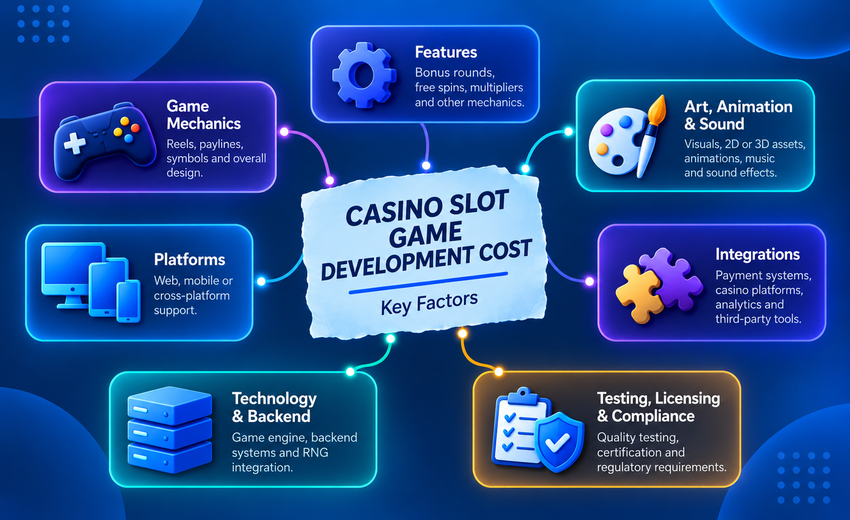
There is no single price for a slot game. The final casino slot game development cost depends on scope, features, art quality, technology, platforms, integrations, and compliance needs.
Average Development Cost
These ranges are useful for planning, but the final quote should depend on the project scope.
| Game type | Indicative range | Main scope | |
| Basic slot game | $10,000–$25,000 | Core reels, symbols, and simple mechanics | |
| Mid-range slot game | $25,000–$60,000 | More features, animation, and integrations | |
| High-end 3D slot game | $60,000–$150,000+ | Advanced visuals and complex gameplay | |
| Multiplayer or live-style slot | $80,000+ | Advanced backend and real-time functions |
These figures are general estimates and not fixed market prices. A detailed scope is needed before treating any range as a project budget.
Cost Factors
Several parts of a project can change the slot game development cost.
- Game mechanics and overall design
- Number of reels, paylines, and symbols
- Artwork, animation, music, and sound effects
- Backend systems and RNG integration
- Web, mobile, or cross-platform support
- Payment, casino, analytics, or third-party integrations
- Testing, licensing, and compliance requirements
A feature that looks small from the player side can still require significant backend or testing Feature-Based Costs
Extra mechanics usually add development and testing work. Common examples include:
- Bonus rounds and mini-games
- Free spins and multipliers
- Progressive jackpot systems
- Custom audio and voiceovers
- Advanced animation and 3D effects
The cost impact depends on how each feature works and how deeply it connects with the rest of the game.
How to Plan Your Budget
Budget planning becomes easier when the core scope is agreed before production starts.
- List the features needed for the initial game release
- Separate must-have features from later additions
- Set milestones for design, development, and testing
- Request a detailed breakdown of the development costs.
- Keep room for testing, revisions, and post-launch work
Defining scope early helps keep casino slot game development cost closer to the planned budget.
What Is the Development Time for a Casino Slot Game?
The casino slot game development timeline depends on the game's mechanics, artwork, technology, team size, testing needs, and approval requirements.
A basic slot game can be completed within a few weeks, whereas a feature-rich game may take several months to develop.
Development Timeline
These are broad planning ranges rather than guaranteed delivery dates.
| Game type | Typical timeline |
| Basic 3-reel slot | 4–6 weeks |
| Standard 5-reel video slot | 2–3 months |
| Bonus rounds and advanced animation | 3–5 months |
| 3D or VR-based slot game | 5–8 months |
| Multiplayer or progressive jackpot slot | 6–9 months |
Actual delivery can change when requirements, revisions, integrations, or compliance work expand.
Time by Development Stage
Breaking the project into stages makes the slot game development time easier to manage.
- Concept and game design: 1 to 3 weeks
- Art and animation: 3 to 6 weeks
- Game math and RNG setup: 2 to 4 weeks
- Development and coding: 4 to 8 weeks
- Testing and final fixes: 2 to 3 weeks
Some activities can run at the same time, so these numbers should not simply be added together.
What Affects Development Time?
The main factors that can extend or shorten a project include:
- Number and complexity of game features
- Amount of animation and visual detail
- Team size and experience
- Number of supported devices and platforms
- Third-party integrations
- Testing and compliance requirements
- Number of review and revision rounds
A clear scope usually makes the timeline easier to estimate and manage.
How to Speed Up Development
Faster development should come from better planning, not from skipping important testing.
- Use suitable game engines and reusable components
- Finalize the main design before production
- Test important features early
- Keep communication between teams clear
- Review requirements before each milestone
A well-organized process can reduce avoidable rework while keeping quality checks in place.
Which Features Help Make a Casino Slot Game Successful?
A slot game needs clear rules, smooth controls, fair outcomes, and a theme that fits the intended audience.
Good casino slot game development focuses on the complete player experience rather than adding as many features as possible.
Must-Have Features
The basic experience should be easy to understand from the first spin.
- Clear game rules
- Smooth reel and spin controls
- Easy-to-read paytable
- Transparent winning combinations
- Reliable random outcomes
These basics create the foundation for additional features.
Bonus Features
Bonus mechanics can add variety when they fit the game's main concept.
- Free spin rounds
- Multipliers
- Pick-and-win bonus games
- Jackpot features
- Special symbols and extra game modes
The right feature depends on the game's theme, mathematics, audience, and overall design.
Graphics and Sound
Visual and audio choices help establish the game's identity.
- Theme-based symbols and backgrounds
- Smooth animations
- Clear win effects
- Matching sound effects and music
- Fast visual feedback after player actions
Good presentation should support gameplay rather than make the interface difficult to use.
Mobile-Friendly Design
Many online casino experiences are accessed through mobile devices, so mobile design should be considered from the beginning.
- Quick loading
- Touch-friendly buttons
- Layouts that fit different screen sizes
- Readable text and paytables
- Efficient use of data and device resources
A responsive design helps the same game feel comfortable across different screens.
Player Engagement
Engagement features should add useful reasons to return without making the game confusing.
- Daily rewards
- Challenges or missions
- Leaderboards where appropriate
- Personalised content
- Progress indicators
The best feature set depends on the audience and business model. More features do not automatically create a better player experience.
What Technology Should You Choose for Casino Slot Game Development?
There is no single technology that fits every slot project. The right choice depends on the game's visual style, target devices, performance needs, integrations, budget, and future plans.
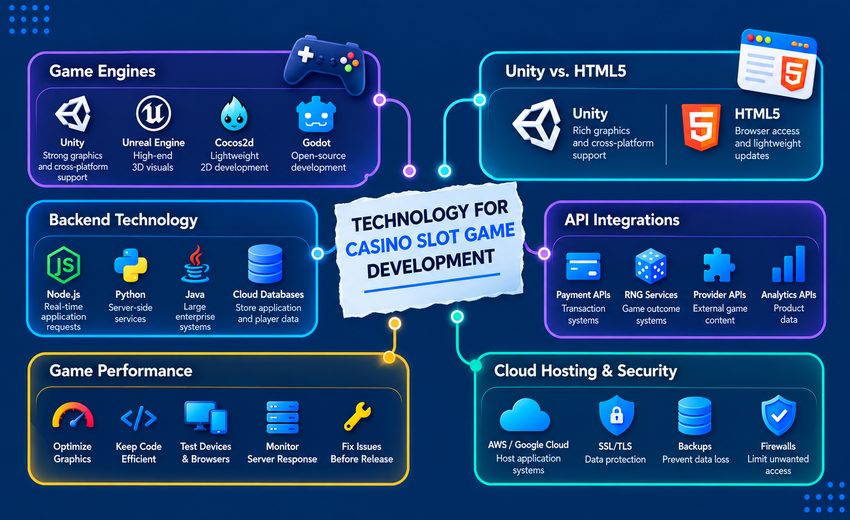
Best Game Engines
Common engines offer different strengths.
| Engine | Key strength |
| Unity | Strong graphics and cross-platform support |
| Unreal Engine | High-end 3D visuals |
| Cocos2d | Lightweight 2D development |
| Godot | Free and open-source development |
The engine should be selected after the team understands the game's actual requirements.
Unity vs. HTML5
Unity and HTML5 can both be used for slot experiences, but their strengths differ.
| Option | Strength | Best fit |
| Unity | Rich graphics and cross-platform support | Complex, feature-heavy slot titles |
| HTML5 | Browser access and lightweight updates | Web-focused, multi-device slot games |
The better fit depends on whether the project needs richer game features, broad browser access, or both.
Backend Technology
The backend handles important services that players may never see.
- Node.js can support real-time application requests
- Python can be used for server-side services
- Java is common in large enterprise systems
- Cloud databases can store application and player data
Backend choices should consider security, scalability, reliability, and the systems that need to connect to the game.
API Integrations
APIs allow the game to communicate with outside services.
- Payment APIs can connect transaction systems
- RNG services can support game outcome systems
- Provider APIs can connect external game content
- Analytics APIs can collect useful product data
Every integration should be tested for reliability, security, and compatibility before launch.
Game Performance
Players notice slow loading, lag, crashes, and delayed responses quickly.
- Optimize graphics for supported devices
- Keep code and assets efficient
- Test different screen sizes and browsers
- Monitor server response and availability
- Fix performance issues before release
Performance testing should be part of development rather than a final step added at the end.
Cloud Hosting & Security
Cloud infrastructure can support availability and scaling when it is planned correctly.
- Cloud services such as AWS or Google Cloud can host application systems
- SSL/TLS helps protect data during transmission
- Backups can limit the effects of losing important data
- Firewalls and access controls can limit unwanted access
Security should cover the game, backend, integrations, user data, and operational systems.
How Do You Choose a Casino Slot Game Development Company?
Choosing a casino slot game development company involves more than checking a portfolio. The team should understand game development, mathematics, testing, technology, security, and the requirements of the intended market.
What to Look For
Before hiring a studio, check whether it can clearly explain:
- Relevant game development experience
- Technology and development approach
- Testing and quality process
- Compliance and certification experience
- Project communication and reporting
- Post-launch support
- Pricing and payment structure
Clear answers make it easier to compare companies based on your actual project needs.
Developer Experience
Relevant experience can be useful when a project includes complex mechanics or multiple integrations.
- Previous work on slot or casino games
- Familiarity with game engines and web technologies
- Understanding of RNG, RTP, and volatility concepts
- Experience with mobile and cross-platform development
- Ability to work with external services and APIs
Ask the team to explain what they personally handled in similar projects.
Portfolio and Projects
A portfolio can show how a company approaches different game requirements.
- Variety of game themes and mechanics
- Quality of artwork and animation
- Mobile and desktop examples
- Technical features and integrations
- Client feedback or references where available
Look for projects that are close to your planned game rather than judging a company only by the number of projects shown.
| Check | Why it matters |
| Similar slot projects | Shows relevant development experience |
| Technical depth | Helps assess complex mechanics capability |
| Compliance knowledge | Helps identify launch requirements early |
| Support model | Clarifies responsibility after release |
Questions to Ask
Ask practical questions before signing an agreement.
- How will you handle testing and compliance?
- What timeline do you expect for this scope?
- What is included in the quoted price?
- How are revisions handled?
- What support is provided after launch?
- Which technologies will you choose for the game, and why?
Written answers can help prevent misunderstandings later.
Hiring Models
Different hiring models suit different project situations.
| Hiring model | Best suited for |
| Fixed-price | Clearly defined projects with agreed scope |
| Dedicated team | Longer development programs |
| Hourly | Smaller changes, maintenance, and fixes |
| White-label | Projects focused on faster deployment |
The best model for a project depends on its scope, level of uncertainty, budget, and expected support.
What Regulations and Certifications Apply to Casino Slot Games?
Casino games operate under rules that can vary by market. Licensing, testing, responsible gaming, security, and technical requirements should be considered before development begins.
Why Compliance Matters
Compliance planning can help protect both players and operators.
- Supports fair game outcomes
- Helps protect user and transaction data
- Addresses responsible gaming requirements
- Reduces avoidable launch and regulatory problems
- Supports operation in applicable markets
Requirements should be checked for the exact jurisdiction and distribution model.
Required Certifications
Independent testing may be required to verify technical and fairness-related aspects of a slot game.
| Compliance area | Purpose |
| RNG testing | Checks random outcome behavior |
| Independent lab testing | Supports technical and fairness verification |
| Local certification | Addresses applicable market requirements |
| Audits and renewals | Supports continuing compliance |
The exact certification path depends on where and how the game will be offered.
Regulatory Requirements
Before launch, businesses may need to address areas such as:
- Appropriate gaming licenses
- Age verification and responsible gaming controls
- Anti-money laundering and KYC requirements
- Data protection and privacy rules
- Advertising and promotional requirements
Because rules vary between jurisdictions, compliance planning should be based on the target market rather than a generic checklist.
Game Testing
Testing should cover both player-facing features and technical systems.
- RNG and outcome testing
- RTP verification
- Functional and bug testing
- Browser and device compatibility
- Security and data protection checks
- Performance and stability testing
Testing helps identify issues before the game reaches players.
Compliance Before Launch
A final review can confirm that the project is ready for the intended market.
- Verify required licensing documents
- Complete applicable compliance checks
- Obtain required independent test reports
- Review payment and security systems
- Complete legal and operational approvals
Building compliance into the project from the beginning is usually easier than addressing major requirements immediately before launch.
Conclusion
Casino slot game development works best when the major decisions are made before expensive production work begins.
Gameplay, mathematics, features, technology, budget, timeline, testing, and compliance all need attention from the start.
Key Takeaways
- Define the game concept and core mechanics first.
- Estimate casino slot game development cost from the actual scope.
- Set a timeline that includes development and testing.
- Choose technology based on the game's real requirements.
- Design for mobile and desktop users when needed.
- Plan security and compliance early.
- Review a development company's relevant experience before hiring.
A clear plan can make the development process easier to manage and gives the team a stronger foundation for launch.
Ready to Build Your Casino Slot Game?
Have a game concept in mind? Talk to Gamecrio Studios for guidance on features, technology, development cost, timeline, testing, and launch planning.
1. What budget should I set aside for a casino slot game?
There is no fixed price. The budget changes with the game's mechanics, artwork, platform, integrations, testing, and compliance work.
2. How many weeks are needed to launch a slot game?
Simple projects may be completed within a few weeks, while games with advanced mechanics, artwork, or integrations can take several months.
3. What should be included in a modern slot game?
A slot can include reels, paylines, winning combinations, bonus rounds, free spins, jackpots, animations, sound, and mobile-ready controls.
4. Which development tools can be used to create slot games?
Tools such as Unity, Unreal Engine, HTML5, Cocos2d, and Godot can be considered based on the game's technical and visual requirements.
5. Is it possible to make one slot game work across different devices?
Yes. A properly planned game can support browsers, smartphones, tablets, and other target devices depending on the selected technology.
6. How are slot game results generated?
Slot outcomes are commonly controlled by an RNG system, which generates results according to the game's programmed rules and mathematical model.
7. What does RTP mean when developing a slot game?
RTP stands for Return to Player. It describes the theoretical share of wagers a game is designed to return over a large number of plays.
8. What checks does a slot game need before release?
Depending on the target market, the project may require RNG checks, independent testing, certification, licensing, security reviews, and other compliance steps.
9. What should I check before hiring a slot game development team?
Review their relevant projects, technical skills, development approach, compliance experience, communication process, pricing, and ongoing support.
10. Can a slot game be built around a custom concept?
Yes. The theme, artwork, mechanics, animations, audio, branding, and other game elements can be planned around your specific concept and business requirements.